
IELTS vs. PTE: Which Test Is Better for UK Universities?
If you’re planning to study in the UK, proving your English language proficiency is one of the first steps in...
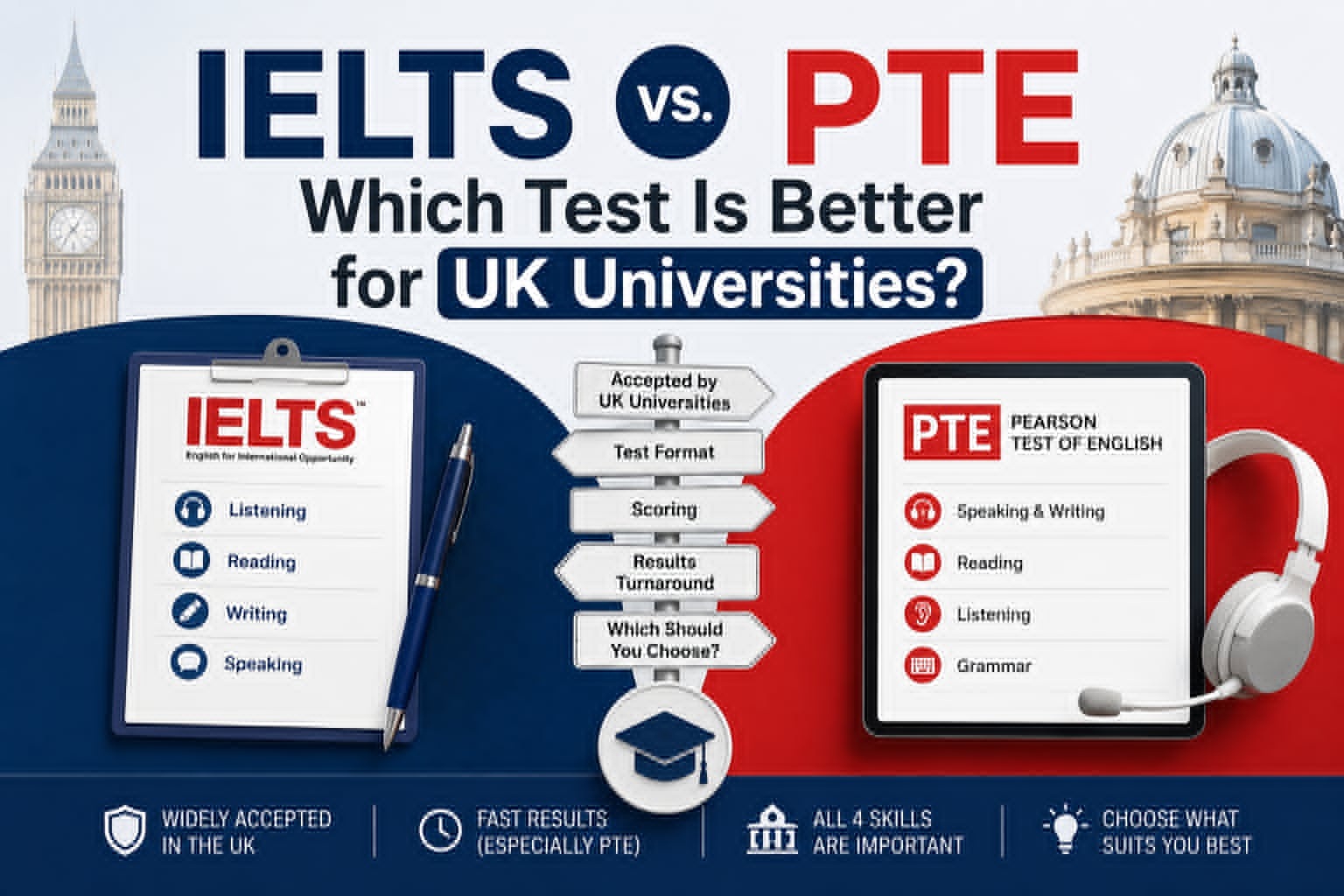
If you’re planning to study in the UK, proving your English language proficiency is one of the first steps in your application journey. The two most popular options are IELTS and PTE Academic, and choosing the right one can affect your admission, your visa timeline, and even your stress levels during preparation. Here’s a simple, easy-to-understand comparison to help you decide which test suits you best in 2026.
Understanding the Basics
IELTS (International English Language Testing System), launched in 1980, is the world’s most widely recognized English proficiency test, accepted by over 12,500 institutions globally. It tests listening, reading, writing, and speaking, and is available in both paper-based and computer-based formats. Speaking is conducted face-to-face with a certified human examiner.
PTE Academic (Pearson Test of English), launched in 2009, is a fully computer-based test that uses AI-assisted scoring. All four skills – listening, reading, writing, and speaking – are assessed in one sitting, with speaking responses recorded through a microphone rather than spoken to a live examiner. PTE is accepted by around 3,000 institutions worldwide, and results are typically available within 48 hours.
Which One Do UK Universities Accept?
Both tests are widely accepted for UK university admissions. However, for your UK student visa, the Home Office only accepts the UKVI (UK Visas and Immigration) versions – IELTS for UKVI or PTE Academic UKVI – since these are classified as Secure English Language Tests (SELTs). Standard IELTS Academic or standard PTE Academic scores are fine for admission but won’t satisfy your visa requirement, so always double-check which version your course and visa route actually need.
Score Requirements: IELTS vs PTE
Score expectations vary by university and course level, but general benchmarks for 2026 entry look like this:
- Undergraduate programs: IELTS 6.0–6.5, or PTE 51–64
- Postgraduate/master’s programs: IELTS 6.5–7.0, or PTE 59–76
- Competitive Russell Group master’s programs (Engineering, Data Science, Computer Science): IELTS 7.0+, or PTE 62 and above
- Healthcare fields (Nursing, Medicine): Regulatory bodies like the NMC and GMC set stricter thresholds – 7.0 in all sections for nursing and 7.5 overall for medicine – regardless of the university’s general requirement
Always check subscore requirements too, since a strong overall score with one weak section can still fail to meet department-level criteria.
Key Differences That Matter
1. Speaking Format
IELTS speaking happens in a live conversation with a human examiner, allowing natural interaction and clarification. PTE speaking is recorded and scored using AI, which can feel less intimidating for students who experience exam anxiety when speaking to strangers.
2. Test Structure and Duration
IELTS separates its four sections, sometimes across different days, for paper-based tests. PTE combines all sections into a single, shorter session, making it a faster overall experience for test-takers comfortable with computer-based formats.
3. Accents and Recognition
Human examiners in IELTS are generally considered better at understanding regional accents compared to AI scoring systems. IELTS also remains the more globally recognized test, particularly favored for migration and visa purposes, though PTE has gained strong traction due to its speed and convenience.
4. Results Turnaround
PTE typically delivers results within 48 hours, while IELTS results usually take about 3 to 5 working days (or up to 13 days for paper-based tests). If you’re working against a tight visa deadline, PTE’s faster turnaround can be a real advantage.
5. Test-Taker Personality Fit
- Choose IELTS if you prefer human interaction, have a strong regional accent, or want the reassurance of face-to-face communication
- Choose PTE if you’re tech-savvy, a fast typer, prefer structured computer-based formats, or need results quickly to meet a visa deadline
Important 2026 Updates to Know
From March 2026, IELTS for UKVI has moved to a fully computer-based format, and by June 2026, all IELTS test versions globally will be computer-only. This narrows one traditional advantage IELTS held – the paper-based option – making the two tests more similar in delivery format than before.
Also note: some UK universities now accept a Medium of Instruction (MOI) letter instead of IELTS or PTE for postgraduate applicants who completed their previous degree in English, particularly at the master’s level. This can be a useful alternative if you want to skip testing altogether, though eligibility varies by university and course.
Which Test Should You Choose?
There’s no single “better” test – it depends on your comfort level, your target university’s requirements, and your visa timeline. If you value the most globally recognized, migration-friendly option and don’t mind a live speaking interview, go with IELTS for UKVI. If you prefer a faster, fully digital experience with quicker results, PTE Academic UKVI is an excellent choice.
Final Thoughts
Both IELTS and PTE are UKVI-approved and widely accepted across UK universities, so your decision should come down to your personal strengths and application timeline. Whichever test you choose, book the correct UKVI version, check your specific course’s score requirements early, and give yourself enough preparation time to hit both the university admission and visa thresholds confidently.