AI Thesis vs Human Thesis: Which One Really Delivers Better Results
Everyone around you seems to have an opinion. Your classmate swears ChatGPT wrote half their thesis and nobody noticed. Someone...
Everyone around you seems to have an opinion. Your classmate swears ChatGPT wrote half their thesis and nobody noticed. Someone else in your department got flagged for AI-generated content and nearly lost their submission. So which story is true and more importantly, which one becomes yours?
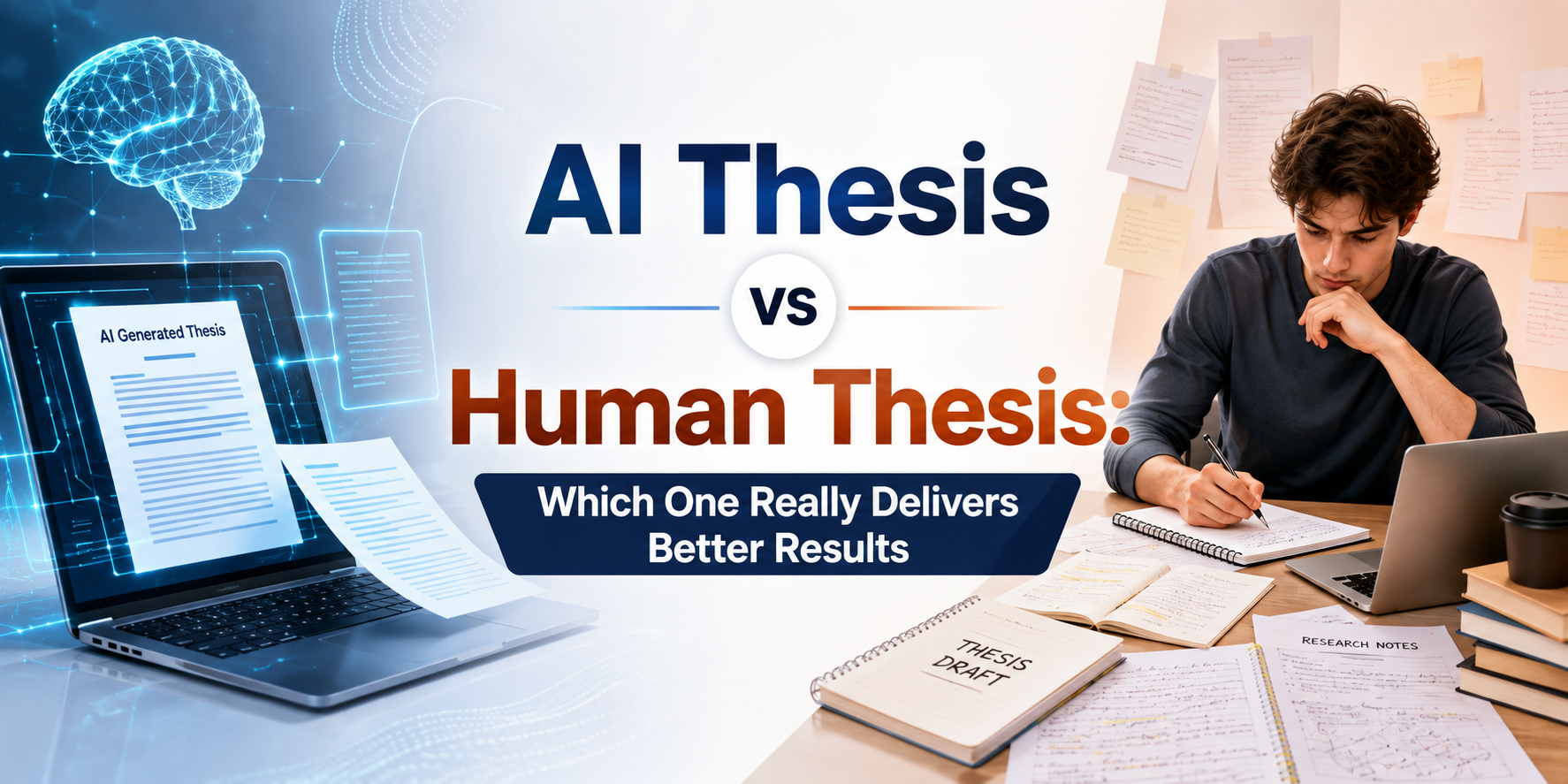
The AI thesis vs human thesis conversation has been going on long enough that you’d think there’d be a clear answer by now. There isn’t really. The internet is full of takes, but most of them are either selling you a tool or scaring you away from one. Neither is actually helping you figure out what to do with dissertation help Ireland when your thesis deadline is creeping closer and your research is still half-formed.The honest answer is messier than most comparisons make it sound. And getting clear on that before you start writing will save you more trouble than any tool will.
What AI Actually Does Well That Humans Can’t While Writing A Thesis
AI is resourceful but you cannot rely totally on it.
Let’s be fair. If you’ve used ChatGPT to untangle a messy argument or asked Grammarly to clean up your academic tone, you already know AI isn’t useless.
For the structural, repetitive, and time-heavy parts of thesis writing, AI genuinely delivers. It can pull together a working outline from your rough notes in minutes. It summarizes dense research papers into digestible points, which is useful when you’re drowning in literature and need clarity fast. Microsoft Copilot can help you draft sections when you’re staring at a blank page with zero momentum. These aren’t small things. They save real hours.
Where AI earns its place is in the early, messy stages of writing. Getting words on the page, organizing your thinking, and flagging weak transitions. For that kind of scaffolding work, it’s genuinely efficient and accessible without breaking your budget.
The problem starts when scaffolding gets mistaken for the final structure.
The Part AI Doesn’t Warn You About
Here’s where the cracks show, and they tend to show up at the worst possible time.
AI generates citations that look completely legitimate. Proper formatting, plausible journal names, realistic author surnames. Except when you go to verify them, they don’t exist. This isn’t a rare glitch. Students across universities have reported submitting bibliographies full of fabricated sources without realizing it until review. One student at a UK university described spending three days tracking down references her AI tool had confidently invented. That’s three days she didn’t have.
Beyond citations, AI has no understanding of your specific research context. It doesn’t know what gap you’re addressing, what your supervisor flagged in your last meeting, or what your institution’s methodology expectations actually look like. It fills those spaces with confident-sounding generalities that experienced academics see through immediately.
The revision cost alone, fixing hallucinated sources, rewriting generic arguments, and restructuring methodology sections, often takes longer than writing the thesis draft would have in the first place. And when something goes wrong, there’s no one accountable. The tool moves on. You don’t. This point could be the decisive factor for most students who are stuck in the AI thesis vs human thesis battle.
What AI Can’t Replicate in Thesis Writing
There’s a difference between content that covers a topic and an argument that actually holds up under academic scrutiny. That difference is judgment and it’s not something you can prompt your way into.
A human thesis writer comes in with subject knowledge, research experience, and the ability to read between the lines of your brief. They understand that your methodology chapter isn’t just a formality, it’s the backbone of your entire argument. They can spot a weak research question before it becomes a failed defense.
What professional writing thesis services actually provide goes beyond putting words together. It includes:
· Aligning your argument with your institution’s academic standards
· Interpreting supervisor feedback and incorporating it meaningfully
· Building a literature review that positions your research, not just summarizes existing work
· Maintaining a consistent academic voice throughout, chapter to chapter
That kind of contextual thinking doesn’t come from a language model running probability on your prompt. It comes from someone who has navigated the same academic process and understands what committees are actually looking for.
The accountability matters too. There’s also someone you can actually go back to if something needs fixing. That matters more than people think until they’re three days from a deadline with a methodology section that doesn’t hold together.
How to Actually Choose Between AI and a Human Writer
Most people frame this as a binary: either you use AI, or you don’t. But that’s not how thesis writing actually works in practice, and it’s not how smart students are approaching it either.
The more useful question is: what does this specific stage of my thesis actually need?
When AI makes sense:
If you’re in the early brainstorming phase, trying to map out your argument or get a rough structure on paper, AI tools can move that process along without costing you much. Low-stakes, early-stage work where the goal is momentum, AI handles that reasonably well.
When human expertise is non-negotiable:
Final submissions, methodology-heavy chapters, and literature reviews that need to position original research, these are not places to cut corners with generated content. The academic risk is real, and the margin for error is narrow. This is where a custom thesis writing service earns its value: what you’re getting isn’t a template filled in with your topic. It is work built around your specific research question, your institution’s expectations, and your supervisor’s direction.
The hybrid approach most people land on:
Use AI to brainstorm, organize, and draft rough material. Bring in human expertise to shape, refine, and finalize. This isn’t cheating the process. It is understanding what each tool actually does well and using both accordingly.
The difference between a generic output and a submission that holds up is almost always the human layer on top.
FAQs
Can I use AI to write my thesis and submit it?
Technically, yes, but most universities now have AI detection tools built into their submission process. AI-generated content often lacks the academic depth and citation accuracy that committees expect, which puts your submission at serious risk.
When it comes to a final submission, how does an AI thesis vs human thesis actually hold up under academic review?
For early drafts and brainstorming, AI can be useful. But for a final submission, human-written work is significantly more reliable. A professional writer understands your research context, handles citations accurately, and produces work that meets real academic standards, which is what your final submission actually needs.
Is a custom thesis writing service worth it for a final submission?
If your thesis carries significant academic weight, the answer is usually yes. A custom service means the work is tailored to your institution’s standards and your supervisor’s expectations, which is exactly what a final submission requires.
Before You Decide, Ask Yourself This
AI didn’t make this decision harder. It just made the options more visible. You still have to figure out what your thesis requires to actually succeed, and that answer looks different depending on where you are in the process, what’s at stake, and how much room you have for error.
If the stakes are low and you’re still finding your footing, use the tools available. If you’re close to submission and the work needs to hold up under real academic scrutiny, that’s not the moment to rely on something that can’t be held accountable.
Your thesis represents months of work and a significant academic milestone. It is better to do the AI thesis vs human thesis comparison and pick the right option for yourself.