How Healthcare Apps Are Improving Communication Between Patients and Providers
A patient I know spent three weeks after a cardiology appointment convinced she needed to ask a follow-up question that...
A patient I know spent three weeks after a cardiology appointment convinced she needed to ask a follow-up question that never felt urgent enough to justify calling the clinic, waiting on hold, leaving a message, and waiting for a callback that might come when she was in a meeting. The question was simple. The friction of asking it was not. So she waited, half-worried, until her next appointment, where her cardiologist answered it in forty-five seconds and noted in the chart that it should have been addressed sooner.
That gap a worried patient, a simple question, a communication system too cumbersome to bridge them is one of the most consistently documented problems in healthcare delivery. It’s not a clinical failure. It’s an infrastructure failure, and it’s exactly the kind of problem that well-built healthcare technology is genuinely well-positioned to solve.
The development teams actually closing this gap understand something important: patient-provider communication isn’t a messaging problem. It’s a trust, workflow, and context problem that happens to require messaging as one of its tools. A Healthcare Apps Development Company that treats it as a messaging problem builds a portal. One that understands the deeper problem builds something patients actually use and providers actually integrate into their clinical practice.
Here’s what that looks like when it’s working.
Asynchronous Messaging That Actually Fits Clinical Reality
The phone call is still the default communication channel in most healthcare settings, and it’s a poor fit for most of what patients and providers actually need to communicate. A phone call requires both parties to be available simultaneously, demands the patient articulate a question clearly under time pressure, and produces no documented record unless someone manually enters a note. For non-urgent questions a clarification about a medication, a question about a symptom change, a request for a referral it’s a mechanism designed for immediacy applied to interactions that don’t require it.
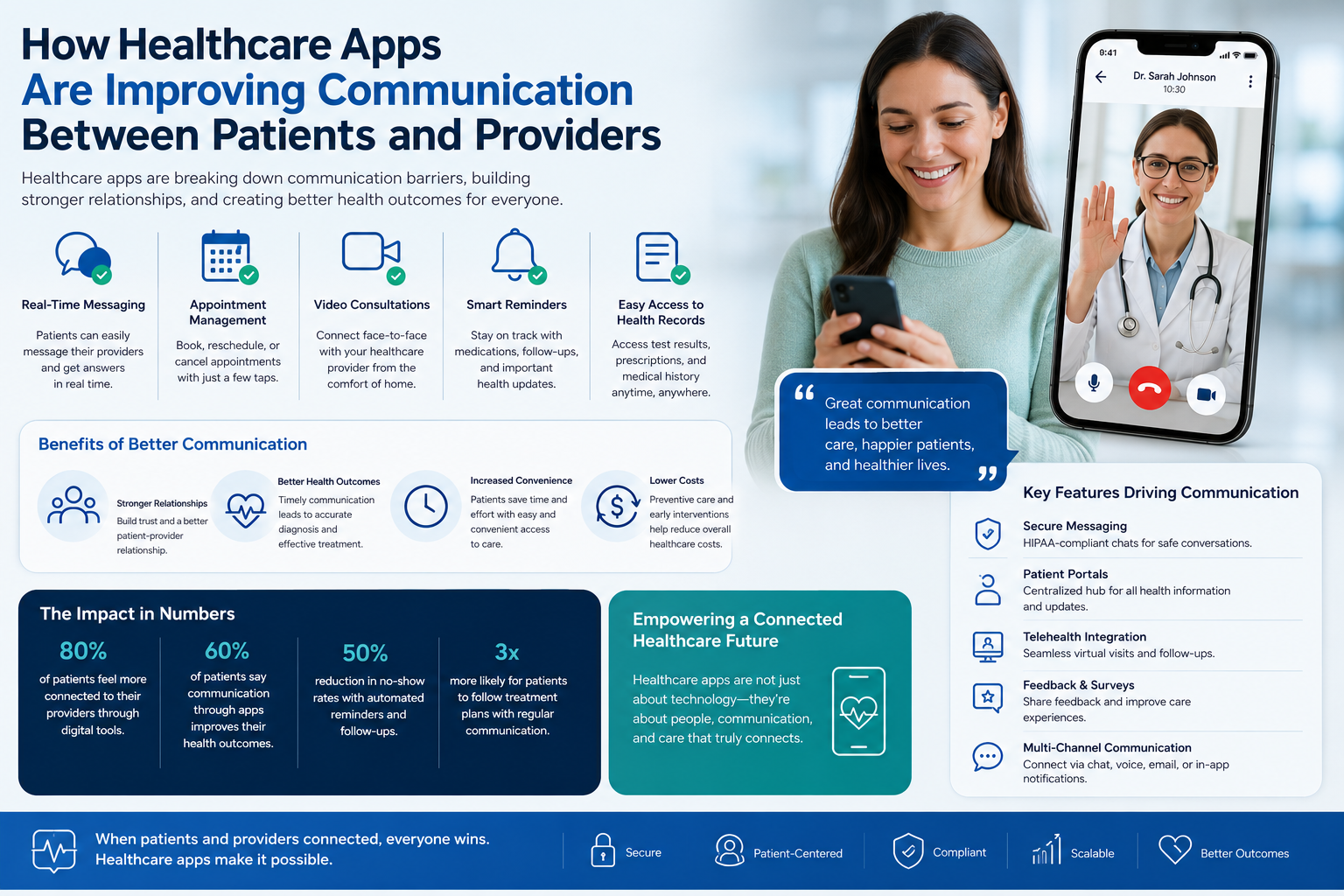
Asynchronous messaging through a healthcare app changes this in specific ways. A patient can compose a message when the question is clear in their mind, attach a photo of a skin change or a medication bottle if relevant, and send it without navigating a phone tree. The provider can respond between appointments, with the full clinical record available for context, and the exchange gets documented automatically.
The apps that have made this work in real clinical settings share a design characteristic: they’ve thought carefully about the provider’s workflow, not just the patient’s. A messaging feature that creates an unmanaged inbox of patient messages isn’t improving communication it’s creating a new burden. The implementations that work have clear triage logic, defined response time expectations that are communicated to patients, and integration with clinical workflow systems that surface messages in the context where providers can act on them without switching applications.
Remote Monitoring That Changes the Information Asymmetry
One of the fundamental problems in chronic disease management is that a provider sees a patient for fifteen or thirty minutes every few months and makes treatment decisions based on what happened in those visits, while the patient experiences their condition every hour of every day. The data the provider needs is primarily generated between appointments. The only way it historically reached the provider was through patient recall, which is imperfect, and paper logs, which are rarely maintained.
Remote monitoring changes this. A patient with hypertension whose blood pressure readings upload automatically from a connected cuff to an app that flags out-of-range values before the next visit gives their provider a different and better picture than a patient who tries to remember their readings from the past three months. A patient with diabetes whose glucose readings, dietary notes, and activity data are visible to their care team enables a level of personalized adjustment that’s simply not possible from quarterly visits alone.
The clinical value is well-established at this point. What’s less well-established is how to make the monitoring actually happen in real patient populations rather than in motivated trial participants. The apps that achieve real adherence in monitoring features are the ones where the monitoring is genuinely low-friction a cuff that connects automatically without manual data entry, a wearable that runs in the background without the patient thinking about it and where the data generates visible feedback that patients find meaningful rather than disappearing into a clinical dashboard they never see.
Care Coordination Across Multiple Providers
Most patients with complex conditions don’t have one provider. They have several a primary care physician, one or more specialists, perhaps a physical therapist or a dietitian and these providers frequently have incomplete pictures of each other’s recommendations and limited bandwidth to communicate directly. The patient ends up as the primary coordinator of their own care, carrying information between providers who aren’t directly connected, sometimes accurately and sometimes not.
Apps that address care coordination have to solve a harder problem than single-provider communication, because they’re creating a shared information layer across providers who may use different electronic health record systems, operate in different organizations, and have different workflows and communication preferences.
The implementations that have made meaningful progress here focus on the patient as the integration point rather than trying to force direct system-to-system integration between every provider in a network. A patient-held health record that travels with them showing each provider what the others have recommended, what medications are currently prescribed, what the overall care plan looks like addresses the coordination problem through a mechanism the patient controls rather than one that requires institutional integration that takes years to negotiate.
Mental Health and the Communication Barrier
Mental health care has a specific communication challenge that differs from other clinical specialties. The barrier to reaching out when something is wrong isn’t primarily logistical it’s emotional. A patient experiencing a deteriorating mood, increasing anxiety, or intrusive thoughts may not call their therapist because calling requires articulating what’s happening in a way that feels impossible when it’s happening.
Low-friction digital check-ins a brief daily or weekly assessment that takes thirty seconds to complete, that the patient’s provider can review before or after a session lower the communication barrier in ways that phone calls don’t. Not because the technology is sophisticated, but because a brief structured response is a different cognitive task than composing and delivering a verbal account of one’s mental state.
The apps doing this well use standardized validated assessments PHQ-9 for depression, GAD-7 for anxiety as the basis for check-ins rather than open-ended prompts, which makes the data clinically meaningful rather than anecdotal and allows providers to track change over time against an objective baseline.
What Providers Actually Need From These Tools
The healthcare apps that get adopted by providers and integrated into real clinical practice share something that has less to do with features than with workflow fit.
A secure messaging feature that routes patient messages into a clinical workflow where they can be triaged, assigned, and responded to without leaving the system providers already work in gets used. One that requires checking a separate application outside the existing workflow doesn’t, because adding another screen to check is a cost providers absorb only if the value is compelling enough to justify it, and for most clinical teams managing full schedules, it isn’t.
Notification design matters more in healthcare apps than almost anywhere else. Alert fatigue the phenomenon where providers receive so many notifications that they begin ignoring them selectively is a well-documented clinical safety concern. A communication feature that generates too many notifications trains providers to ignore them, which is a worse outcome than the feature not existing. The design discipline of deciding what’s worth notifying about, and building systems that interrupt only for things that warrant interruption, is where a lot of healthcare app communication features fail.
The Trust Layer Underneath All of It
Patients share health information with providers they trust. They share it through digital channels with providers they trust and whose digital tools they also trust. The communication improvements described here are only available to apps that have earned the trust required for patients to actually use them.
That trust has two components. The first is clinical trust in the provider, which exists before the app enters the picture. The second is trust in the app itself that messages sent will reach the provider and be read, that health data shared won’t be misused, that the platform will work correctly when it matters.
The apps that have built this second form of trust have done it through consistency and transparency. Consistent response times that match communicated expectations. Clear information about how data is handled. Behavior that matches what patients were told to expect when they enrolled. None of this is sophisticated. All of it is how trust gets built in any relationship, and its absence is why so many technically sound healthcare communication features go unused despite real patient need for exactly what they offer.