
All-in-One Organ-on-a-Chip Systems: A Complete Guide
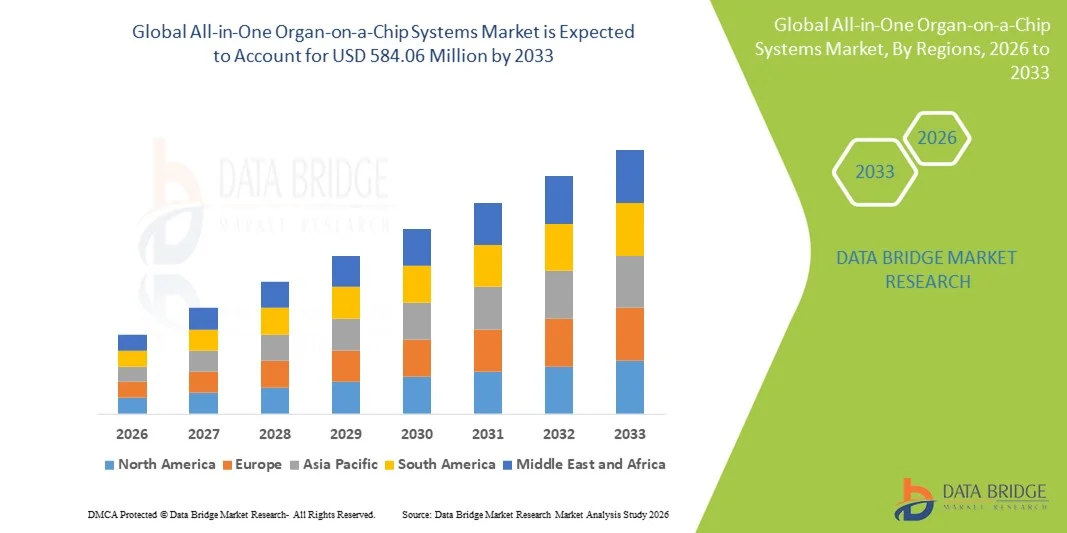
The Global All-in-One Organ-on-a-Chip Systems Market was valued at USD 235.22 Million in 2025 and is expected to reach USD...
Introduction
The field of biomedical research is undergoing a quiet revolution, driven by the need for more accurate, ethical, and efficient models of human biology. Traditional cell cultures and animal models, while valuable, often fail to fully replicate human physiological responses. This gap has led to the emergence of organ-on-a-chip (OoC) technology – microengineered platforms that mimic the structure and function of human organs. Among the most promising advancements within this field are all-in-one organ-on-a-chip systems, which integrate multiple functionalities into compact, user-friendly platforms.
Definition
All-in-One Organ-on-a-Chip Systems are integrated microengineered platforms that combine multiple organ-mimicking tissues, fluidic control, sensing, and data acquisition within a single compact device. They are designed to replicate key structural, mechanical, and biochemical aspects of human physiology in vitro, enabling simultaneous modeling of organ function, inter-organ interactions, and responses to drugs or toxins in a standardized and scalable format.
Understanding Organ-on-a-Chip Technology
Organ-on-a-chip systems are microfluidic devices, typically the size of a USB drive, that contain living human cells arranged to simulate tissue- and organ-level functions. These chips incorporate channels lined with cells, through which fluids flow to mimic blood circulation, mechanical forces, and biochemical gradients found in the human body. By recreating a realistic cellular microenvironment, OoC platforms provide insights into disease mechanisms, drug responses, and toxicity that are often missed by conventional models.
While early OoC devices focused on single organs – such as lung, liver, or heart – researchers soon recognized the need for greater integration, automation, and scalability. This realization paved the way for all-in-one organ-on-a-chip systems.
What Are All-in-One Organ-on-a-Chip Systems?
All-in-one organ-on-a-chip systems are integrated platforms that combine multiple components – cell culture chambers, microfluidic control, sensors, pumps, and data acquisition – into a single, cohesive unit. Unlike modular or custom-built setups that require external tubing, pumps, and controllers, all-in-one systems are designed for ease of use, reproducibility, and broader adoption beyond specialized engineering labs.
These systems may support:
- Single-organ models with advanced environmental control
- Multi-organ or “body-on-a-chip” configurations
- Parallelized experiments for higher throughput
- Real-time monitoring of biological and biochemical parameters
By reducing technical complexity, all-in-one platforms enable biologists, pharmacologists, and clinicians to focus on experimental outcomes rather than device assembly.
Key Components of All-in-One Systems
1. Integrated Microfluidics
At the heart of any organ-on-a-chip system lies microfluidics. All-in-one systems incorporate precisely engineered channels and valves that control fluid flow without the need for bulky external equipment. Integrated pumps – often pneumatic, peristaltic, or electro-osmotic – allow continuous perfusion, which is essential for maintaining cell viability and physiological relevance.
2. Built-in Sensors and Monitoring
Modern all-in-one platforms frequently include embedded sensors to monitor parameters such as pH, oxygen levels, temperature, electrical activity, and barrier integrity. Real-time data collection enables continuous observation of tissue responses, providing dynamic insights that static assays cannot offer.
3. Mechanical and Biochemical Stimulation
To more accurately replicate in vivo conditions, many systems integrate mechanical cues such as stretching, compression, or shear stress. For example, lung-on-a-chip models simulate breathing motions, while gut-on-a-chip systems reproduce peristaltic movements. Combined with controlled biochemical gradients, these features enhance physiological fidelity.
4. Automation and Software Control
All-in-one organ-on-a-chip systems often come with dedicated software that controls fluid flow, timing, stimulation patterns, and data acquisition. Automation reduces user error, improves reproducibility, and allows long-term experiments with minimal manual intervention.
Advantages Over Traditional Models
Improved Physiological Relevance:
Because they use human cells arranged in three-dimensional, dynamic environments, all-in-one OoC systems better reflect human-specific responses than animal models. This is particularly important for drug development, where species differences can lead to costly failures in clinical trials.
Reduced Cost and Time:
Although initial investment may be higher, all-in-one systems can significantly reduce long-term costs by streamlining workflows, minimizing reagent use, and decreasing reliance on animal testing. Faster, more predictive results also shorten development timelines.
Ethical Benefits:
By offering viable alternatives to animal experimentation, organ-on-a-chip technologies align with the principles of the 3Rs – Replacement, Reduction, and Refinement – supporting more ethical research practices.
Scalability and Standardization:
All-in-one platforms are designed with standardization in mind, making it easier to compare results across experiments and laboratories. This scalability is essential for regulatory acceptance and industrial adoption.
Applications in Research and Industry
Drug Discovery and Development:
Pharmaceutical companies are increasingly adopting all-in-one organ-on-a-chip systems to evaluate drug efficacy, toxicity, and pharmacokinetics. Liver-on-a-chip models, for instance, are widely used to assess drug-induced liver injury, one of the leading causes of drug withdrawal.
Disease Modeling:
These systems enable researchers to recreate disease-specific microenvironments, including inflammation, fibrosis, cancer, and infectious diseases. Patient-derived cells can be used to create personalized disease models, opening the door to precision medicine.
Toxicology and Environmental Testing:
All-in-one OoC platforms are valuable tools for assessing the safety of chemicals, cosmetics, and environmental pollutants. Their ability to provide human-relevant toxicity data makes them attractive alternatives to traditional toxicology assays.
Multi-Organ and Systems Biology Studies:
Advanced all-in-one systems can connect multiple organ models – such as liver, heart, and kidneym – on a single platform. These interconnected models allow researchers to study systemic interactions, metabolism, and off-target effects that cannot be captured in isolated organ systems.
Challenges and Limitations
Despite their promise, all-in-one organ-on-a-chip systems face several challenges. Technical limitations include maintaining long-term cell viability, ensuring consistent cell sourcing, and accurately scaling physiological parameters. Additionally, regulatory frameworks for validating and approving OoC-based data are still evolving.
Cost and accessibility can also be barriers for smaller laboratories, although ongoing commercialization and standardization efforts are steadily lowering entry thresholds.
Future Trends of All-in-One Organ-on-a-Chip Systems Market
Integration of AI and Data Analytics:
Future all-in-one organ-on-a-chip systems will increasingly integrate artificial intelligence and advanced data analytics to handle complex, real-time biological data. AI-driven models will enhance predictive accuracy in drug screening, toxicity assessment, and disease modeling, enabling faster and more informed decision-making.
Expansion of Multi-Organ and Body-on-a-Chip Platforms:
The market is moving toward more sophisticated multi-organ and body-on-a-chip systems that replicate systemic human responses. These integrated platforms will allow researchers to study organ–organ interactions, metabolism, and long-term drug effects with greater physiological relevance.
Growth in Personalized and Precision Medicine:
Advances in stem cell technology, particularly induced pluripotent stem cells (iPSCs), will drive personalized organ-on-a-chip models. This trend supports precision medicine by enabling patient-specific drug testing and tailored therapeutic strategies.
Increasing Regulatory Acceptance and Commercial Adoption:
As validation studies grow and standardization improves, regulatory agencies are expected to increasingly recognize organ-on-a-chip data. This will accelerate adoption across pharmaceutical, biotechnology, and toxicology markets, positioning all-in-one systems as mainstream research tools.
Growth Rate of All-in-One Organ-on-a-Chip Systems Market
According to Data Bridge Market Research, the All-in-One Organ-on-a-Chip Systems market was estimated to be worth USD 235.22 million in 2025 and is projected to grow at a compound annual growth rate (CAGR) of 12.04% to reach USD 584.06 million by 2033.
Learn More: https://www.databridgemarketresearch.com/reports/global-all-in-one-organ-on-a-chip-systems-market
Conclusion
All-in-one organ-on-a-chip systems are transforming the way researchers study human biology. By combining microfluidics, living cells, sensors, and automation into unified platforms, these systems offer unprecedented insight into organ function and disease processes. As technology continues to mature, all-in-one OoC platforms are poised to become indispensable tools in biomedical research, reducing reliance on animal models and accelerating the path toward safer, more effective therapies.